Why Restaurant Groups Are Drowning in Tools (And What to Do About It)
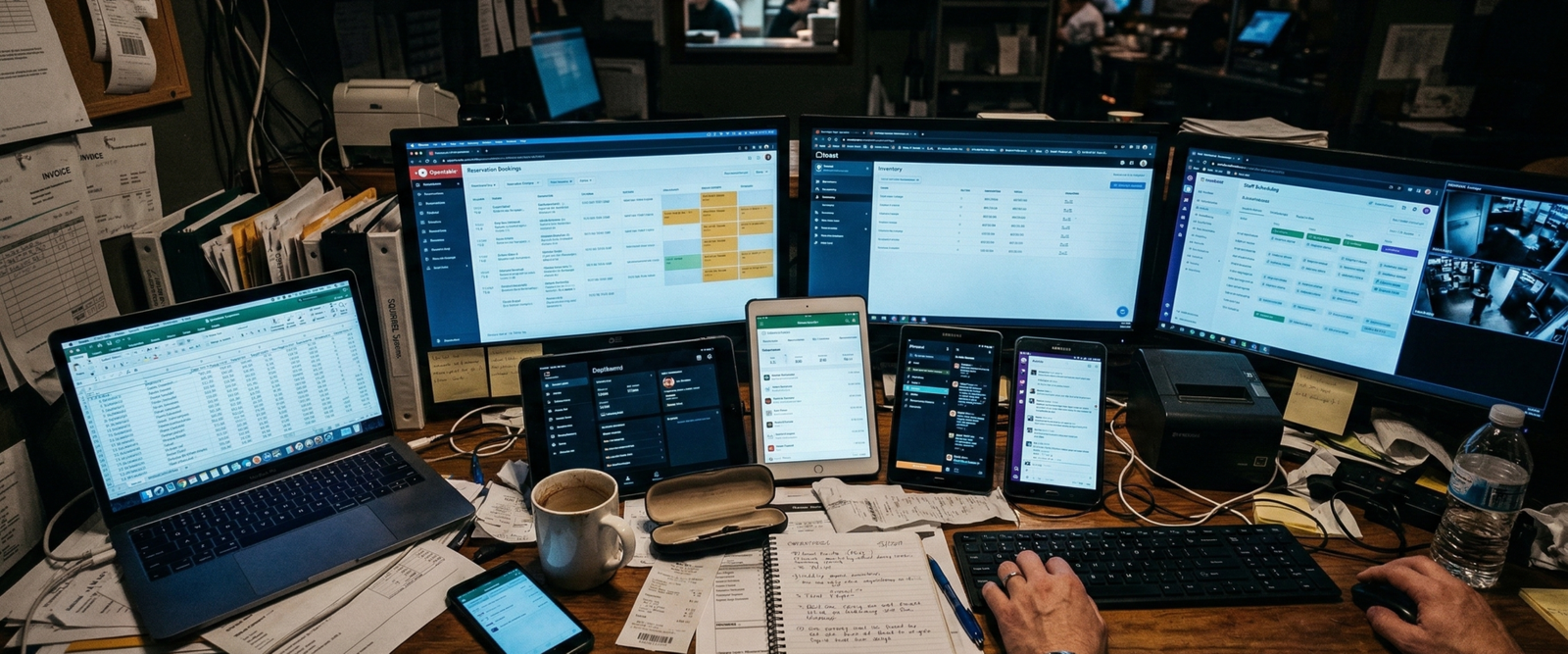
The average multi-location restaurant group uses 12-15 different software systems. Scheduling in one app. Tips in a spreadsheet. Training in a shared drive. Reservations somewhere else. POS data trapped in yet another system.
Sound familiar?
This isn’t a technology problem. It’s an integration problem. And it’s costing you more than you think.
The Real Cost of Fragmentation
When your systems don’t talk to each other, your managers become the integration layer. They copy data from one screen to another. They reconcile numbers manually. They answer the same questions repeatedly because no one has a single source of truth.
Here’s what that actually looks like:
Time waste. A general manager at a busy restaurant spends 5-10 hours per week on data entry and reconciliation tasks that should be automated. Multiply that across 15 locations and you’re looking at 150+ hours of management time — every single week — burned on administrative work.
Errors compound. Manual data entry has a 1-4% error rate. When that data flows into tip calculations, payroll, or financial reporting, small mistakes become expensive problems. One miskeyed shift time can cascade into compliance issues.
Decisions get delayed. When it takes three days to pull together a labor cost report because data lives in five different places, you’re managing with outdated information. By the time you see the problem, it’s already in your P&L.
Why This Keeps Happening
Restaurant technology has historically been sold in silos. POS vendors sell POS. Scheduling vendors sell scheduling. HR platforms sell HR. Each promises to be “the one system you need” — but none of them actually are.
The result? Operators end up with a patchwork of point solutions, each solving one problem while creating new integration headaches.
And the “integration” these vendors offer? Usually it’s a CSV export. Maybe an API that requires custom development. Rarely anything that actually works out of the box.
What Actually Works
The restaurant groups that have solved this problem share a few things in common:
1. They think in systems, not tools.
Instead of asking “what’s the best scheduling app?” they ask “how does scheduling connect to labor cost, tip distribution, and payroll?” The tool matters less than how it fits into the operational flow.
2. They consolidate where it makes sense.
Not everything needs to be in one platform. But the core operational loop — workforce, tips, scheduling, and execution — should be connected. That’s where fragmentation hurts the most.
3. They treat data as infrastructure.
Your operational data is an asset. When it’s trapped in disconnected systems, you can’t use it. The best operators invest in getting their data unified so they can actually learn from it.
The Path Forward
You don’t need to rip and replace everything. But you do need to be intentional about where you’re headed.
Start by mapping your current stack. Where is data created? Where does it need to go? Where are your managers manually bridging gaps between systems?
Those gaps are your roadmap. Fix the most painful ones first, and build toward a connected operational layer over time.
The goal isn’t perfection. It’s reducing the friction that slows down your teams and hides problems until they’re expensive.
Infraxeon builds technology infrastructure for restaurant groups. If you’re dealing with fragmented systems and manual workflows, let’s talk.
Leave a Reply